Friday, 3 September 2010

Counting raindrops in Thar

x
Rainwater slowly trickles down a window at a home in Karachi
When I was penning my thoughts to share with you all, water was pouring down from the clouds in Karachi. Rain drops were splashing on my window and with each drop that dripped I pictured water traveling down the Himalayas, through the streams and rivers, making its way to the ocean, changing into vapours, reaching the skies and then pouring outside my window. The beauty of the water cycle system is bewildering!

When this precious water floods our streets and finds its way to the drains, I feel we could do so much with this it only if we knew how to utilise it. The idea of rainwater harvesting has occupied my mind for some time and prompted me to learn more about it.

One day when I was talking to a friend, who works at a highly respected fertiliser company, he told me that his company has been harvesting rain water in the Thar Desert for slightly more than a year. This made me jump with excitement! I wanted to know all about the project.

Imagine that you live in a desert where it only rains just once in a year, your house does not have any water pipelines or link to canals, your only water source is a well that is three to four kilometres away. Both male and female members of your family need to travel for hours to fetch water. Your children will not go to schools and your principle bread winner will not be able to work because they spend half the day fetching water. The same cycle is repeated everyday through out the year.

It’s hard for me to imagine myself in such a situation. Sadly, the people living in the Thar Desert face this life every day. Wells are their only source of water and the water table is declining by 11 per cent each year. Health problems are increasing since most of the water available was saline.

Fortunately a concerned group with close links to the people of the Thar community contacted Engro Polymer and Chemical Limited (EPCL) – who produce geomembranes that are used to avoid water seepage in ponds and other water bodies.

Water conservation models were built for various villages, houses and schools. It fills my heart with joy to share with all of you that the water collected last year in June from the regular rains, lasted till it rained again this year. People are using rain water through out the year which is accessible within 15 minutes.

A local checking for available water


They are healthier and wealthier as the principle bread winners now have more time to devote to their jobs and have worked to improve their living standards. Children can go to schools. Moreover, local livestock looks well nourished as well. Now that they have water in the desert, they are even trying to grow their own crops.

Isn't it heart warming to know that some people quietly did their work and changed the lives of thousands and are still 
working to help all the estimated 1.2 million people of the Thar desert.

The concept of rainwater harvesting has captivated me. I dream of a Pakistan where rainwater harvesting becomes a common practice. Our agricultural lands, deserts and even the urban centres could learn to use rainwater wisely.

Children transporting water which they need to survive instead of being in school


Monday, 23 August 2010

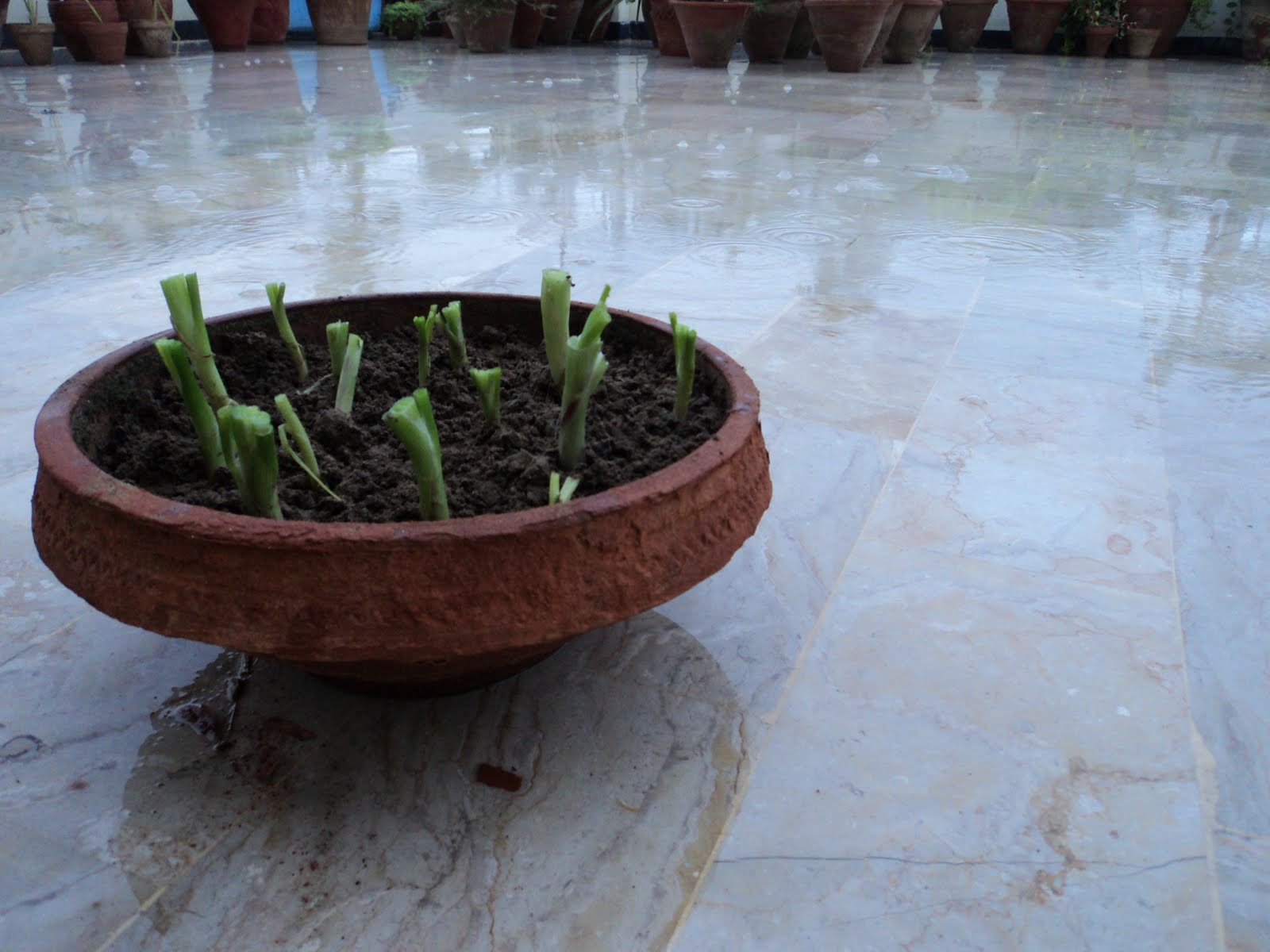
A Bowl Full of Leeks

Leeks from the market
People say that rainy days are for the gardeners to take a break, but I disagree.

Rainy day is a perfect reason to be out in your garden. Karachi has seen monsoon rains during the past few weeks.one rainy day I decided to plant leeks.

I have had many unsuccessful attempts to grow leeks and onions from seeds. But there are always shortcuts. Here is a simple way to grow your leeks!

1. Buy leeks from the market. The younger bulbs the better.
2. Prepare a container that is wide but not very deep.
3. Chop off most of the leaves. 
4. Plant the heads in the soil.

Let few drizzles fall on the newly planted leeks. Keep it in shade for next few days.
Heads of the Leeks freshly planted.

Growing crops cant get any easy than this. Plant some leeks!

Happy Gardening!

Zahra 

Tuesday, 17 August 2010

Down Came the Rain

It rained here yesterday and the plants have enjoyed it the most. Here are some pictures I took after the rain.


Almanda flowers look happy after a morning shower.

Everything about the rain is beautiful..even a single drop collected on a leaf .

I feel every plant has its own way of celebrating rain.

A fallen flower floats in the rain water.


Thursday, 5 August 2010

Lets Chit Some Potatoes Today !


Every one loves potatoes. Why not grow your own this season?

For those who don't know, I have a roof top garden where I also grow crops in pots.Potatoes are my favorite crop that can be grown in bags, bins and large containers. This afternoon I decided to chit some potatoes.

Chitting potatoes simply means to encourage tubers to sprout before planting. The easiest way to grow potatoes is in bags, bins or large containers. Here is how you can start chitting your potatoes:

Selecting potatoes:
You can simply select any potato that you like the best. Its hard to find potato seeds ( which are basically baby potatoes) here in Karachi, so I use the potatoes I get from the grocery store. Make sure the potatoes you select are healthy and do not show any signs of a virus or infection.

Eyes of a Potato:
Yes! A potato has eyes. Notice there are black spots all over a potato. Those are its eyes from where the shots will begin to appear.

Chitting:
Before your potatoes go in a container or a grow bag, you want them to develop shots. For encouraging that, place your potatoes in an empty eggs tray or any empty cardboard box with maximum eyes upwards. Place this tray in a well lit  place but not in direct sunlight.

As soon as you see sprouts emerging, leave only 2-3 on each potato and pinch off any extras.

Last year I selected a sack to grow potatoes. This year I am using a huge plastic tub. It gives me more space and I also like its color!

Lets chit some potatoes together and share our experiences.

To learn how my potatoes are doing in a tub and to know what to do next, stay tuned!

For any problems you face growing your potatoes write to me crops.in.pots@gmail.com

Happy Gardening!


Monday, 2 August 2010

Learning to Grow Paradise From a Seed


Grade 3 at the vegetable patch besides an iceberg lettuce plant.

Vacations are coming to an end and that means another year of productive farming can begin!

Teaching gardening to young people is rewarding on many levels.The best part is that you get paid to practice your hobby.

I can proudly say that I belong to a team that are the pioneers of teaching gardening at the school level. It was the combined effort of Ms Sabrina Dawood and Mr Tofiq Pasha Mooraj to introduce gardening as a subject and to spread the awareness about the environment. For me, it was a dream come true! Dawood Public School took this initiative last year in July, and now we are beginning our second year.

Teaching more than 800 students who belonged to grade 1-8 has taught me many lessons. The most important one is that a love of nature is in every heart – all we need to do is make children realize that there is nothing more human than being close to nature. The other lesson was that a love of nature is contagious!

First grade students get introduced to the pleasures of gardening
When my students started planting crops in their pots, everyone was amazed to see the results and soon, farming fever began to spread. Management, teachers, parents and domestics all fell in love with gardening activities and passionately participated as well. Guests who visited us couldn’t stop themselves from jumping into the vegetable patch! They couldn’t resist touching our dazzling eggplants and tasting our tomatoes. The feeling you get when you see people falling in love with farming and becoming one with nature is divine!

I was lucky that my colleague Mr. Fahim Zuberi took out time to organize gardening activities for my students and together we launched DIGS Dawoodian Inspirational Gardeners' Society which quickly gained popularity across the campus.


I still remember the day I entered the school and saw my students watering their pots before the assembly and later saw them having lunch beside their pots. They did not want their plants to be out of their sight! It filled my heart with an unexplainable joy. At one point other teachers started to hate me because students were always thinking and talking about their plants. They were concerned if they sprouted or not. After each class they wanted to run to the windowsill to see their progress. Eventually, even those teachers got addicted to gardening.

Grade 8 student with her corn plant

Now I am beginning to miss my students and their repeated questions, ” Ma’am, when will my seed sprout?” ” Can I take my plant home for the weekend, please?” ” Ma’am! There is one more leaf in my basil plant!” That is the best reward a teacher can get.

I can already foresee my students making their gardens beautiful and taking care of the environment long after they will leave the school. I am glad they are coming back.

This morning was spent preparing the gardens for them. We weeded a vegetable patch and have arranged their pots. Now we are all ready to welcome our young gardeners !


Published on Express Tribune :http://blogs.tribune.com.pk/story/868/learning-to-grow-paradise-from-a-seed/

further reading

crops in pots